Google Ads for Real Estate: Complete Guide for Builders and Developers
Learn how to use search intent, location targeting, landing pages, conversion tracking, and disciplined budgets to generate better real estate leads.
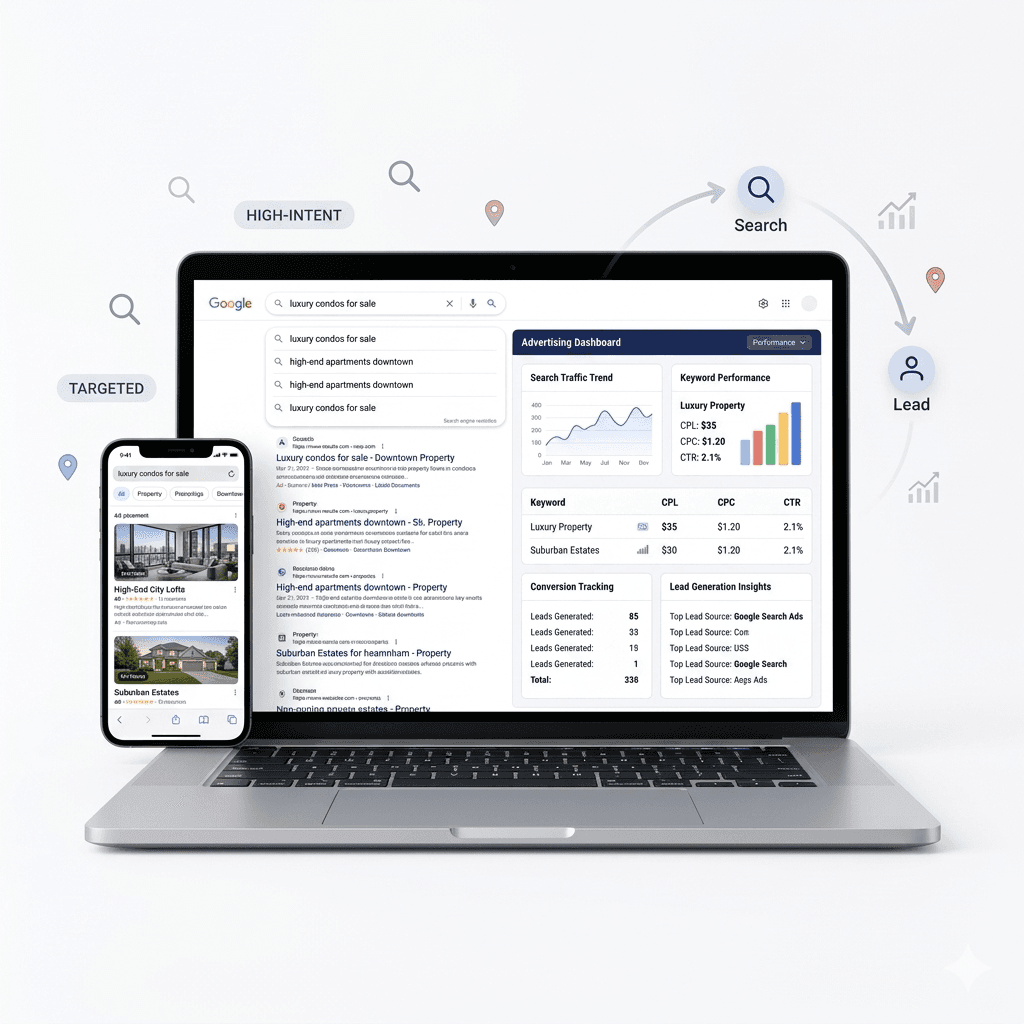
Google Ads remains one of the most powerful channels for real estate marketing because it connects builders and developers with people who are already searching. A buyer typing a property query into Google is not passively scrolling. They are comparing locations, budgets, builders, possession dates, and lifestyle needs. With the right structure, Google Ads can help your project appear at the exact moment that buyer is looking for options.
Why Google Ads Works
Real estate has a long decision cycle, but search intent is a strong signal. People search when they have a question or need. That need may be "flats near metro station", "new launch in Noida", "villas in Pune", or "best investment property in Mumbai". Google Ads lets you place your project in front of these prospects with a message that directly answers their search.
The platform also gives you measurable control. You can track calls, forms, WhatsApp clicks, brochure downloads, and site visit requests. This makes it possible to identify the campaigns and keywords that generate qualified opportunities rather than judging performance by impressions or traffic alone.
High intent creates better conversations
A search user often has a more specific requirement than a social media user. They may already know the preferred micro-market, budget range, configuration, or builder category. When your ads and landing pages reflect that intent, the sales team receives enquiries with clearer context and a better chance of progressing to a site visit.
Search Campaigns
Search campaigns should be the foundation for most real estate Google Ads accounts. They target people actively typing relevant queries. Start by separating campaigns by project, location, and intent level. A campaign for branded project searches should not share a budget with generic location keywords because the cost, conversion rate, and lead quality will be different.
Structure by keyword theme
Create tightly themed ad groups for phrases like "2 BHK in location", "luxury apartments in location", "new launch projects", "ready possession flats", and "builder name projects". This helps your ad copy stay relevant. If the user searches for a location-specific project, your headline should mention that location and your landing page should support it immediately.
Use responsive search ads with multiple headlines, but keep them grounded in real project information. Highlight the configuration, location, connectivity, possession status, amenities, and enquiry action. Avoid vague lines that could apply to any property campaign.
Location Targeting
Location targeting is critical because most real estate projects have a defined catchment. A premium project in one city may attract buyers from nearby business districts, existing residential pockets, investor-heavy markets, and NRI audiences. A budget housing project may need a tighter radius around employment hubs and transport routes.
Target presence, not only interest
Review Google Ads location settings carefully. In many cases, you want people who are present in or regularly in your selected locations, not users merely showing interest from unrelated geographies. Study location reports after the campaign starts. If certain areas spend budget without producing qualified enquiries, exclude or reduce focus on them.
Budget Planning
Budget planning should begin with sales goals, not arbitrary daily spend. Estimate the number of bookings needed, the site visit to booking ratio, the qualified lead to site visit ratio, and the expected cost per qualified lead. This gives you a more realistic media budget and prevents underfunded campaigns from producing weak data.
In competitive real estate markets, cost per click can be high. That is not automatically a problem if the lead quality and booking value justify it. The bigger issue is spending on irrelevant clicks, poor landing pages, or weak tracking. Start with enough budget to test meaningful keyword themes, then move spend toward campaigns that produce qualified calls and site visits.
Conversion Tracking
Conversion tracking is the difference between guessing and optimizing. At minimum, track form submissions, phone calls, click-to-call actions, WhatsApp clicks, and brochure downloads. For stronger reporting, connect offline conversions from your CRM so Google Ads can learn which leads became qualified, visited the site, or booked a unit.
Measure qualified outcomes
Not every enquiry has equal value. A student looking for a job, a broker researching inventory, and a buyer with the right budget should not all be treated as identical conversions. Feed lead quality back into reporting wherever possible. This helps bidding strategies optimize toward business outcomes instead of raw form volume.
Landing Pages
Google Ads traffic should rarely go to a generic homepage. A campaign needs a dedicated landing page that matches the keyword and ad promise. The page should be fast, mobile first, and direct. Real estate buyers want project facts: location, price indication, configurations, floor plans, possession status, amenities, connectivity, gallery, and trust signals.
Keep the enquiry action visible throughout the page. Use sticky call or WhatsApp buttons on mobile, clear form labels, and concise copy. The landing page should reduce uncertainty. If users have to hunt for pricing, location, or configuration details, many will leave without enquiring.
Keyword Strategy
Keyword strategy should balance reach with precision. Start with high-intent terms around configuration, location, project type, possession stage, and builder brand. Use exact and phrase match to control spend while you learn. Once conversion tracking and negative keyword lists are strong, carefully test broader match types with smart bidding.
Build a negative keyword system
Negative keywords are essential in real estate. Exclude terms related to jobs, careers, rent if you sell only, construction suppliers, free listings, legal templates, unrelated cities, and low-fit property types. Review search term reports weekly during launch periods. This habit keeps budgets focused on buyers instead of curiosity clicks.
Common Mistakes
Many real estate campaigns fail because they chase traffic instead of intent. Broad keywords, weak negative lists, generic ad copy, and homepage traffic can burn budget quickly. Another mistake is changing campaigns too often before enough data has accumulated. Google Ads needs consistent signals to optimize well.
Builders and developers also lose performance when sales teams do not update lead status. If marketing cannot see which leads were qualified, visited the site, or booked, it becomes difficult to scale the right campaigns. A strong Google Ads setup includes both media optimization and sales feedback.
Conclusion
Google Ads can be a high-performing channel for real estate when it is built around buyer intent. The strongest accounts use clear campaign structure, precise location targeting, realistic budgets, reliable conversion tracking, dedicated landing pages, and disciplined keyword management. When these pieces work together, Google Ads becomes more than a lead source. It becomes a measurable sales pipeline.
To see how Google Ads fits into a complete marketing pipeline, read our guide on generating high-quality real estate leads in 2026.
Back to Blog